A long life in poor health is a burden; a long life in good health is a gift.
For 150 years, human life expectancy has climbed. Today, millions are living into their 80s, 90s, and even 100s. But while our lifespan has increased, our healthspan — the years lived with independence, vitality, and purpose often lags behind.
Too often, people assume decline is inevitable. One day you’re doing fine, the next it feels like your independence has slipped away. Families are caught off guard. Caregivers scramble. Health systems react too late.
But decline isn’t fate. It can be measured, tracked, and changed. That’s why we created the Functional Aging Score (FAS) — a simple, powerful way to know if you’re truly aging well.
This is the first time healthy aging is being quantified in a meaningful way. For decades, “healthy aging” has been a vague, subjective phrase. The Functional Aging Score makes it more objective — giving you a number that reflects how healthily you are aging, and showing you how to improve it over time.
👉 Take the Functional Aging Score Test Now »
What the Functional Aging Score Is
The Functional Aging Score is not about the number of candles on your birthday cake. It’s about how well you can actually live, move, think, and connect every day.
It bridges the gap between chronological age (the years since you were born) and functional age (how your body and mind are really performing).
The Tale of Two 82-Year-Olds
- Ruth, 82: Walks her dog daily, shops for groceries, attends family dinners, and plays bridge with friends. Her days are full and meaningful.
- Helen, 82: Exhausted by stairs, rarely leaves home, forgets what day it is, spends hours isolated in front of the TV.
Same chronological age. Two very different functional ages.
👉 Find out your Functional Age here »
Why Function Matters as Much as Lab Results
Lab results and medical diagnoses are important. But they don’t tell the full story. Sometimes your labs are “normal” but you’re struggling to function. Other times, you may have a medical condition yet still live an active, independent life.
That’s why function must be measured and valued as highly as clinical data. Just as we take daily medicines for blood pressure or diabetes, we should be taking daily steps to preserve and improve function.
Ultimately, the most important question is: Are you able to move through life well, to enjoy your everyday?
That means being able to:
- Rise from a chair with ease
- Walk confidently on all kinds of surfaces without fear of falling
- Carry groceries or household items without strain
- Remember names, appointments, and life’s moments
- Stay joyful, purposeful, and connected
Function is not an optional “bonus.” It’s central to independence and quality of life.
How the Functional Aging Score Works
Your Functional Aging Score is based on four key domains:
- Strength – e.g., carrying your groceries, lifting daily objects
- Mobility & Balance – e.g., walking steadily across different surfaces, avoiding falls
- Cognition – e.g., remembering names, appointments, problem-solving
- Mood & Resilience – e.g., staying positive, social, and emotionally strong
The score also adjusts for body composition (BMI), since extremes in weight impact independence.
Scoring Across the Decades
- In your 40s and 50s, strength and fitness are weighted more heavily.
- In your 60s and 70s, mobility and balance matter most.
- In your 80s and beyond, cognition and resilience become central.
This ensures the score reflects what matters most at every stage of life.
Two Ways to Test:
- Self-Assessment: A 15-question test about your everyday abilities.
- Coach-Led / In-Person: Adds objective measures like grip strength and walking speed for a more precise score.
The result is your Functional Age — the “real-world” age your body and mind are performing at.
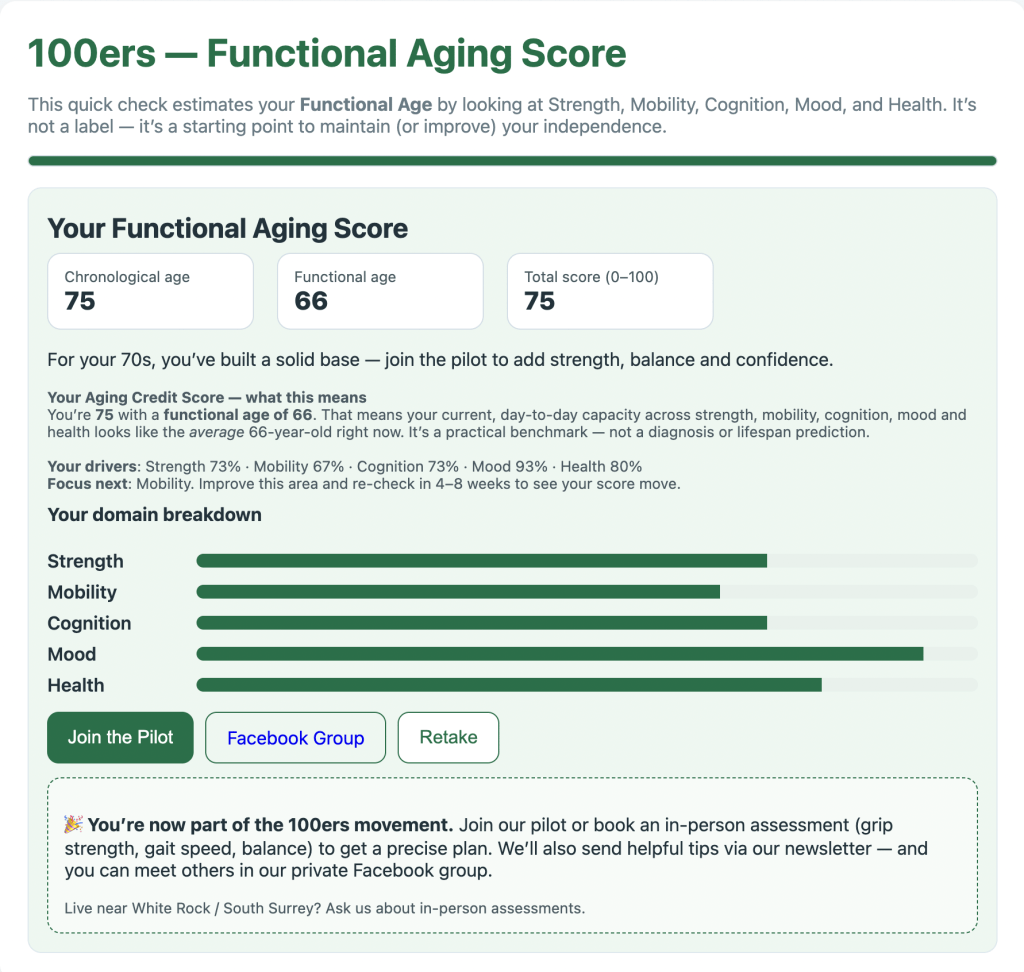
Example Report
Here’s an example of the Functional Aging Score report you’ll receive after completing the test:
Care Plan by Score
Your number is only the starting point. What matters most is what you do with it.
- Score 80+ (Functional age younger than chronological): Maintain & Optimize. Keep strong habits, add challenges, stay preventive.
- Score 60–79: Strengthen & Preserve. Target weaker domains with exercise, social engagement, or mental training.
- Score <60: Restore & Protect. Work with caregivers, physiotherapists, or health professionals to restore key functions and protect independence.
How Often Should You Reassess?
Just like blood pressure or cholesterol, your functional age is a living number.
- We recommend reassessing every 3 months.
- This cadence lets you see progress, catch risks early, and adjust your plan before decline sets in.
👉 Take your first Functional Aging Score today »
Decline Is Not Fate — It’s a Signal
Functional decline doesn’t happen overnight. It builds slowly, then shows up suddenly — a fall, a hospitalization, or loss of independence. The Functional Aging Score helps you see those signals early.
150 years ago, a 15-year-old had just an 11% chance of reaching 80. Today, that chance is 70%.
If you know it’s going to rain tomorrow, you carry an umbrella. In the same way, if you know you’re likely to live into your 80s or beyond, you prepare — by measuring, tracking, and improving your functional age.
The Functional Aging Score is your umbrella. It protects you, guides you, and helps you extend not just your life, but the quality of your life.
Why It Matters for Everyone
- For Individuals: Know your true aging trajectory. Track it quarterly. Improve it with targeted action.
- For Families: Spot risks early. Support smarter. Plan for independence instead of reacting to crisis.
- For Caregivers & Agencies: Use the score as a common language to set goals, design care plans, and measure progress — not just compliance.
- For Communities: Offer workshops, screenings, and preventive programs to keep people stronger, longer.
The 100ers Commitment
At 100ers, we believe longevity should be intentional — not just adding years to life, but adding life to years. A “100er” is someone who aims to thrive into their 90s and 100s with vitality, connection, and purpose.
The Functional Aging Score is the first step. It gives you — and your family, caregivers, or healthcare providers — a roadmap.
Don’t wait for decline to decide for you. Measure today. Improve tomorrow. Thrive for decades.
 100ERS